
Special topics in CAE simulation
ULAS-E-VAN: 34% Less Mass - MORPHOTEC Reports on Results of a Lightweight Design Research Project
430 kilograms less body structure mass while maintaining high structural performance: The completed ULAS-E-VAN research project demonstrates the potential of simulation-driven lightweight design for electric delivery vehicles. MORPHOTEC, based in Aachen, Germany, contributed extensive work in topology optimization, structural mechanics, and component development to the publicly funded collaborative research project.
How can the mass of electric delivery vehicles be significantly reduced without compromising the required strength and stiffness of their load-bearing structures? This question was at the heart of the ULAS-E-VAN research project (“Ultra-Lightweight Body Structure for a Lightweight Electric Commercial Vehicle”).
The results of the research consortium coordinated by Ford-Werke GmbH demonstrate considerable lightweight design potential: The mass of the investigated vehicle body structure was reduced from 1,266 to 836 kilograms in the optimized concept. This represents a mass reduction of 430 kilograms, or approximately 34%.
The comparison covers the body structures including doors and the integrated racking system, but not the complete vehicle with chassis, drivetrain, and battery.
MORPHOTEC, an engineering company based in Aachen that had already reported on the objectives of the research project in October 2022, now presents the completed research results and selected contributions from its own development work.
Simulation-Driven Lightweight Design Instead of Conventional Engineering
For battery-electric commercial vehicles, vehicle mass is a major factor influencing energy consumption and available payload. Particularly in urban delivery operations, vehicles must meet demanding payload requirements while operating as energy-efficiently as possible.
The ULAS-E-VAN research project therefore developed alternative load-bearing vehicle structures combining different materials and functions.
The approaches investigated included aluminium supporting structures, optimized cast components, large-area sandwich panels, and the integration of a load-bearing racking system into the vehicle body structure.
A key element was simulation-driven development. Rather than designing components solely on the basis of conventional engineering approaches, their load paths, material distributions, and wall thicknesses were analysed and optimized using numerical methods.
These methods included finite element analysis (FEA), topology optimization, parametric optimization techniques, and manufacturing process simulations.
34% Less Mass – Improved Torsional and Bending Performance
The consortium's joint final report documents the comparison between a scaled reference structure and the optimized ULAS-E-VAN concept.
The results demonstrate not only the reduction in body structure mass from 1,266 to 836 kilograms, but also the high structural performance of the lighter design.
In the numerical analysis, the optimized structure achieved 40% higher torsional stiffness than the reference structure. At the same time, floor deflection under the investigated bending load case decreased to just 60% of the original value.
For the investigated curb-loading cases, diagonal portal deformation under one-sided loading on the left matched the reference value, while loading on the right resulted in a value 10% higher than the reference.
These results demonstrate that a substantial reduction in material usage does not necessarily lead to a corresponding decrease in structural performance. Instead, the decisive factor is distributing the available material according to the mechanical loads and design requirements.
MORPHOTEC Develops and Optimizes Complex Lightweight Structures
As part of its research subproject, MORPHOTEC was directly involved in the simulation-based development of various structural components.
One focus was the topology optimization of cast structural nodes and load-bearing frame structures. The investigations examined how material could be distributed within predefined design spaces to achieve the required stiffness with the lowest possible mass.
In addition to mechanical loads, manufacturing constraints were considered, including minimum wall thicknesses and geometric restrictions arising from the intended casting processes.
The investigations revealed both considerable lightweight design potential and the limitations of individual material and manufacturing concepts. Different cast node variants were evaluated in terms of mass, stiffness, and manufacturability. Not every optimized design met all requirements for integration into the overall vehicle structure.
Another focus was the simulation-based development of a die-cast aluminium A-pillar structure as an alternative to a high-strength steel design.
By combining topology optimization, explicit dynamic simulation, and integrated automatic wall thickness optimization, the mass of the investigated component was reduced from 18.4 to approximately 14.2 kilograms. This corresponds to a mass reduction of around 23% while meeting the specified mechanical requirements.
These investigations demonstrate how load-oriented rib design and targeted adjustments to local wall thicknesses can unlock the lightweight potential of metallic components.
Development of a Modular, Scalable Battery Housing
Another research focus was the development of a modular, scalable battery housing for electric commercial vehicles. Different manufacturing and joining processes, the integration of battery cooling, and structural behaviour under crash loading were investigated. In addition to extensive simulations and component testing, a hot-formed battery tray was manufactured as a technology demonstrator.
Optimized Battery Protection Structures Through Targeted Bead Design
MORPHOTEC also investigated ways of improving the mechanical performance of structural components in the area of underbody battery protection while maintaining a constant wall thickness.
The focus was on a large floor protection panel whose deformation under defined local loads was investigated using numerical simulations.
Automated optimization of the stiffening bead geometry enabled substantial reductions in deflection under the investigated loading conditions.
In the so-called bollard impact test, local loading of the battery protection panel was simulated using an impactor with a diameter of 100 mm and an applied test force of 36 kN. In an extended investigation covering 35 different impactor positions, deflection was reduced by up to 57% compared with the original geometry, without increasing the wall thickness of the floor protection panel.
This result demonstrates the potential of geometric optimization methods, particularly for large sheet-metal structures where component mass must be kept as low as possible.
Functional Integration as a Key to Lightweight Design
In addition to optimizing individual components, the project pursued another approach: integrating multiple functions into shared load-bearing structures.
One example is the delivery vehicle's racking system. While conventional vehicles are frequently equipped with cargo-area fittings installed after vehicle production, the ULAS-E-VAN concept incorporated a racking system that also contributes to the stiffness of the vehicle body.
This allowed load-bearing frame structures, panel components, and racking elements to be considered together and optimized with regard to their material distribution.
Combining different materials and making targeted use of additional load-bearing functions offered considerable potential for reducing the overall mass of the vehicle body structure.
Economically Promising Results
The consortium's joint final report also includes a simplified economic assessment of the developed body structure.
The economic comparison indicated calculated additional costs of approximately €0.92 per kilogram of mass saved when the racking system integrated into the load-bearing structure was included. Without including the racking system, the additional costs amounted to approximately €9 per kilogram of mass saved. The calculation was based on simplified assumptions regarding material and manufacturing costs. A separate comparison of the required capital investment costs was not carried out.
The results highlight the economic significance of functional integration, in which existing structural components take on additional functions.
Potential for Future Electric Commercial Vehicles
The concepts and simulation methods developed within the ULAS-E-VAN project demonstrate the lightweight design potential that can be achieved by systematically combining structural mechanics, topology optimization, material selection, and manufacturing-oriented engineering.
For battery-electric delivery vehicles, a reduced body structure mass can provide additional flexibility in terms of payload capacity and energy consumption.
The mass reduction of 430 kilograms documented in the joint final report is the result of the development and simulation activities of the entire research consortium. The investigated concepts and technology demonstrators provide a basis for further industrial development; they do not imply that the optimized complete body structure has been implemented in series production.
MORPHOTEC was able to further develop the optimization and simulation methods used during the research project and incorporate them into its engineering services portfolio.
The knowledge gained can also be transferred to other industrial applications requiring high mechanical performance with minimum material usage.
About the ULAS-E-VAN Research Project
The collaborative research project ULAS-E-VAN (funding reference 03LB3086) was supported under the Lightweight Construction Technology Transfer Programme of the German Federal Ministry for Economic Affairs and Energy.
The project was coordinated by Ford-Werke GmbH. Other consortium partners included Benteler GmbH, Voxeljet AG, C-TEC GmbH, Altair Engineering GmbH, MORPHOTEC, and RWTH Aachen University, represented by the Institute of Structural Mechanics and Lightweight Design (SLA) and the Institute for Automotive Engineering (ika). Franken Guss GmbH & Co. KG also participated in the research consortium but withdrew from the project ahead of schedule.
MORPHOTEC carried out the subproject “Application Development for the Simulation and Optimization of Lightweight Structures in the E-VAN Using Inspire Cast, OptiStruct and FEMFAT” under funding reference 03LB3086G.” under funding reference 03LB3086G.
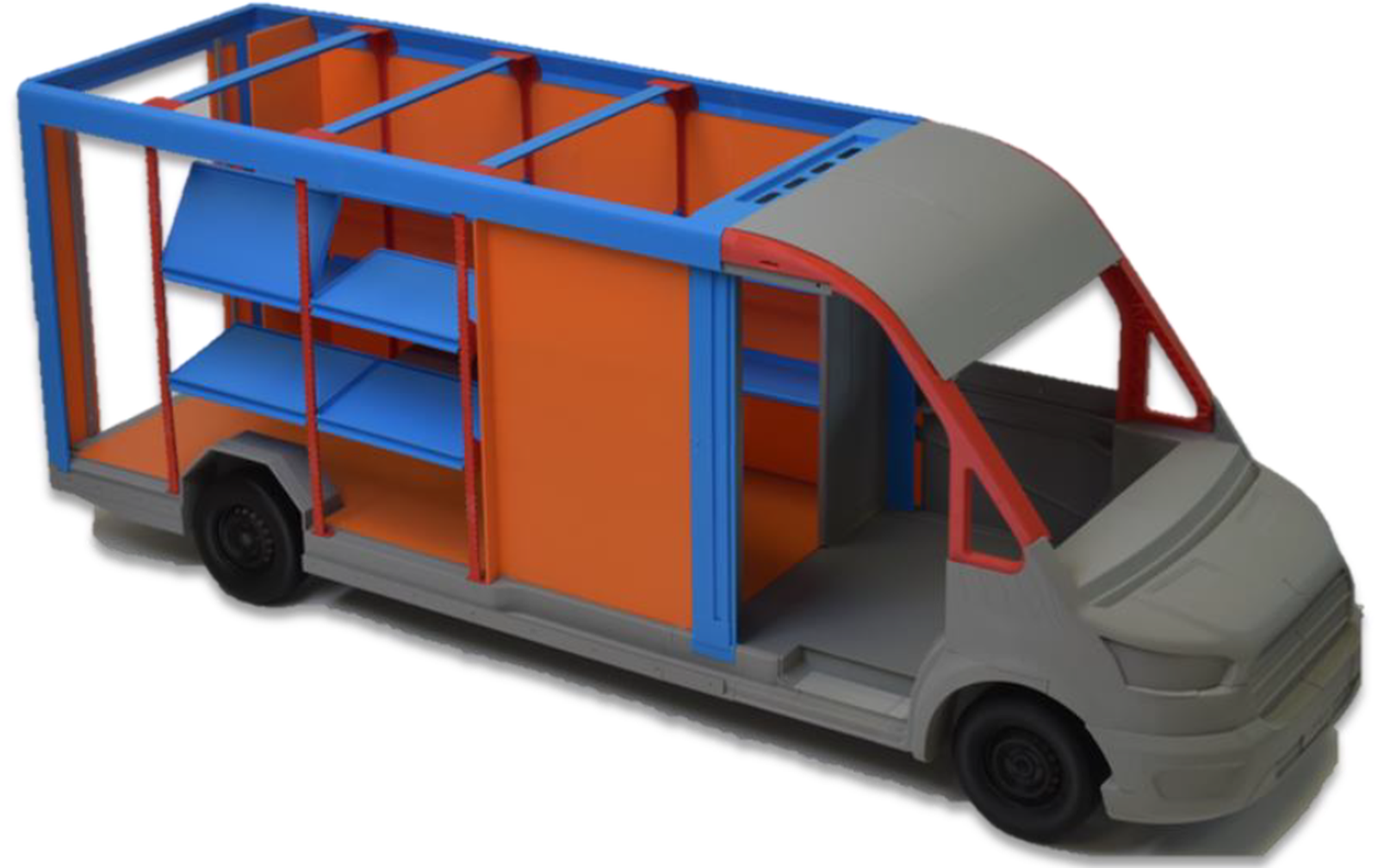
ULAS-E-VAN: 3D-printed model with integrated shelving, 1:6 scale. (C) ULAS-E-VAN Research Consortium, Joint Final Report, Fig. 103.